
Statutory Shift with Practical Consequences
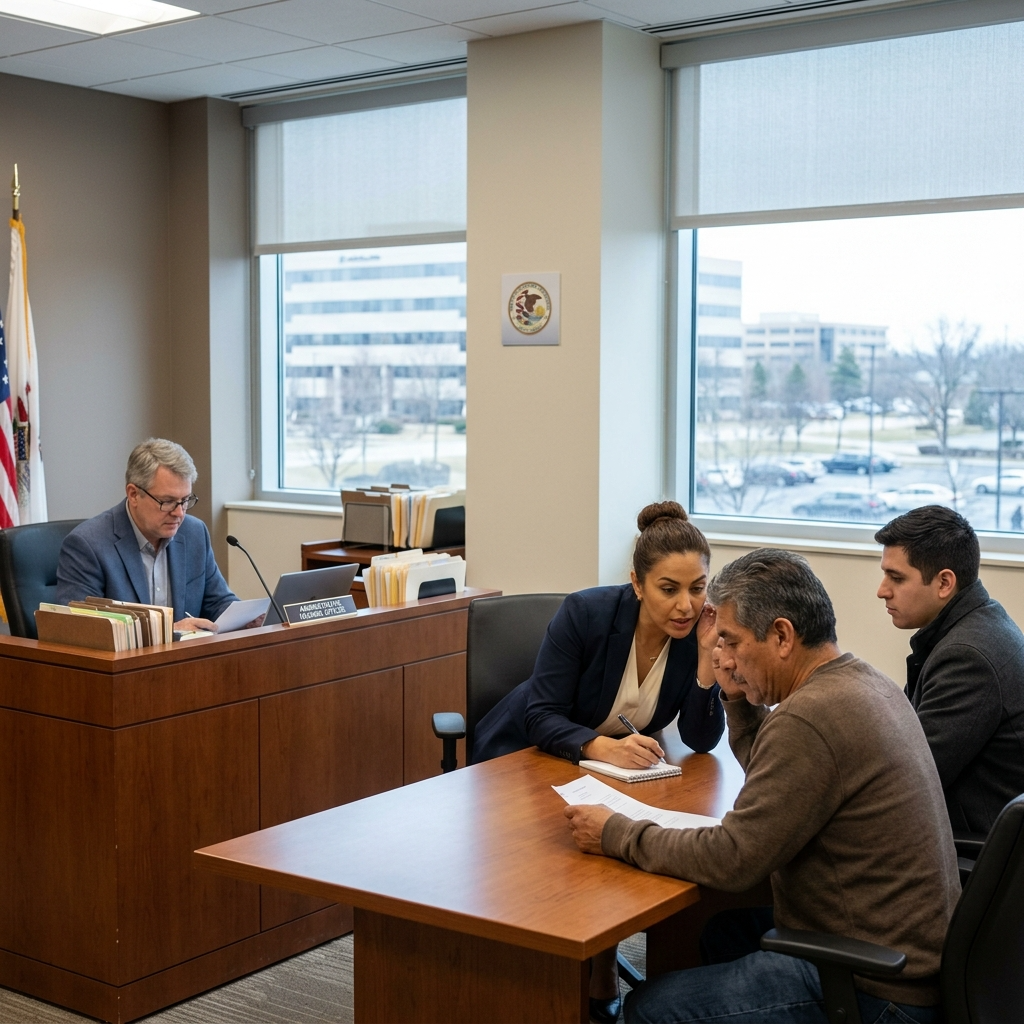
In July 2025, Illinois amended its Administrative Procedure Act to require state agencies to provide interpreters for individuals who are not proficient in English during administrative hearings.
The change may appear procedural. It is not.
Administrative hearings determine eligibility for public benefits, professional licenses, housing matters, regulatory penalties, and other rights that directly affect livelihood and stability. For many individuals, these proceedings carry consequences equal to trial court matters.
Illinois has now made language access in those hearings explicit, structured, and enforceable.
What the Illinois Law Requires
The amended statute does more than acknowledge language needs. It imposes defined duties.
Under the new law:
- Hearing notices must include an enclosure informing recipients of their right to request interpretive assistance and translation of the notice.
- An administrative law judge must inquire whether a self-represented litigant or witness requires interpretive assistance.
- A self-represented litigant, witness, or indigent person may request interpretive assistance at any time during a hearing.
- If requested, or if the administrative law judge determines it is necessary, the agency must appoint a foreign language interpreter at no cost for substantive hearings.
- For nonsubstantive hearings, agencies may use a non, foreign language interpreter if the administrative law judge examines the interpreter for competency.
- All interpreters must make specified affirmations regarding their role and neutrality.
This moves interpreter access from discretionary practice to statutory obligation.
How Illinois Compares to Other States
Most states already operate under Title VI requirements if their agencies receive federal funding. That means they must provide meaningful language access in administrative proceedings.
However, many states rely on policy guidance rather than detailed statutory mandates. Enforcement mechanisms vary. Some agencies maintain strong internal language services programs. Others rely heavily on ad hoc arrangements.
Illinois stands out for codifying:
- Mandatory notice of language rights
- A judicial duty to inquire
- Clear appointment requirements
- Mid-hearing request authority
It is not the first state to address interpreter services at the agency level. But it is among the more explicit in embedding legal interpretation requirements directly into its administrative procedure statute.
In that sense, it reflects a broader national trend among interpreting companies in the USA and interpreting agencies in California and beyond: language services are becoming formalized expectations rather than discretionary accommodations.
Why Administrative Hearings Require Professional Interpreters
Administrative proceedings often move quickly. They generate a record. They apply regulatory standards. They may determine ongoing eligibility for housing, healthcare, or licensure.
A hearing without proper legal interpretation creates risk.
If a participant cannot understand testimony, respond accurately, or review translated documents, the outcome becomes vulnerable to challenge. Appeals may follow. Remands increase administrative cost.
Professional interpreters are not interchangeable with casual bilingual staff.
Legal interpreting services require:
- Neutrality
- Terminology fluency
- Procedural awareness
- Clear role boundaries
Whether the hearing uses in person interpretation or virtual interpretation, the interpreter must be competent and independent.
The Illinois statute recognizes that distinction by requiring affirmations and competency review.
Implications for Counsel and Agencies
Even when agencies carry statutory responsibility for appointing a foreign language interpreter, counsel should verify compliance.
Before the hearing:
- Confirm who the assigned interpreter is.
- Verify credentials if the matter is substantive.
- Determine whether simultaneous interpretation or consecutive interpretation will be used.
- Confirm whether documents requiring legal translation or certified legal translation will be addressed.
Administrative records matter. If interpretation services are flawed, the issue may not surface until appeal.
Preparation reduces that risk.
For agencies, the law increases demand for structured interpreter coordination. Interpretation and translation agencies must now be prepared to provide qualified professional interpreters on tighter timelines.
Broader Impact on Language Services
Illinois’ amendment reinforces a national pattern: language access is moving from policy preference to statutory requirement.
As interpreter obligations expand:
- Demand for certified interpreters increases.
- Agencies require reliable legal translation and document translation support.
- Hybrid models combining in person interpretation and virtual interpretation become more common.
- Standards for legal interpreting services receive closer scrutiny.
For providers of global translation services and interpretation services, administrative hearings are no longer peripheral work. They are core compliance environments.
Kaplan’s Role as an Interpretation and Translation Agency
Kaplan Interpreting Services provides court certified interpreters, professional interpreters, legal interpretation, legal translation, certified legal translation, and document translation across more than 200 languages .
Services include deposition interpreter coverage, in person interpretation, virtual interpretation, and interpreter services for conference attendees in governmental and regulatory settings .
Structured intake, dialect identification, and credential verification are standard. A 98 percent same-day interpreter match rate and 99.7 percent on-time arrival reflect coordinated oversight .
As states formalize interpreter requirements at the agency level, preparation becomes essential.
Bottom Line
Illinois’ July 2025 amendment does not invent language access in administrative hearings. It clarifies and strengthens it.
The trend is neither radical nor isolated. It reflects growing recognition that legal interpretation at agency hearings affects enforceability, appeal risk, and fairness.
Interpreter coordination should be treated as part of case preparation, not an afterthought.
When the record matters, language access matters.

CEO & Founder
Born in Dallas, Texas, Alexandra grew up surrounded by Spanish, English, Arabic, and Italian. After moving to Venezuela, Spanish became her primary language. She holds a Master's in Healthcare Administration from Washington University in St. Louis and is a California court certified and medical interpreter.
She founded Kaplan Interpreting Services after seeing an industry that treated interpreters as interchangeable and clients as ticket numbers. She built a protocol-driven operation where every interpreter is hand-selected and credentialed for the specific setting, every client has a dedicated point of contact, and risk management is built into every assignment.
Her career reached a historic milestone when she interpreted the conversation between President-elect Biden and Pope Francis. That assignment, along with engagements for Nike and the Summit of the Americas, set the standard for every client engagement that followed.
"The same protocols that protected that historic conversation now protect every assignment we handle."