
What Maine's New ASL Interpreter Law Means
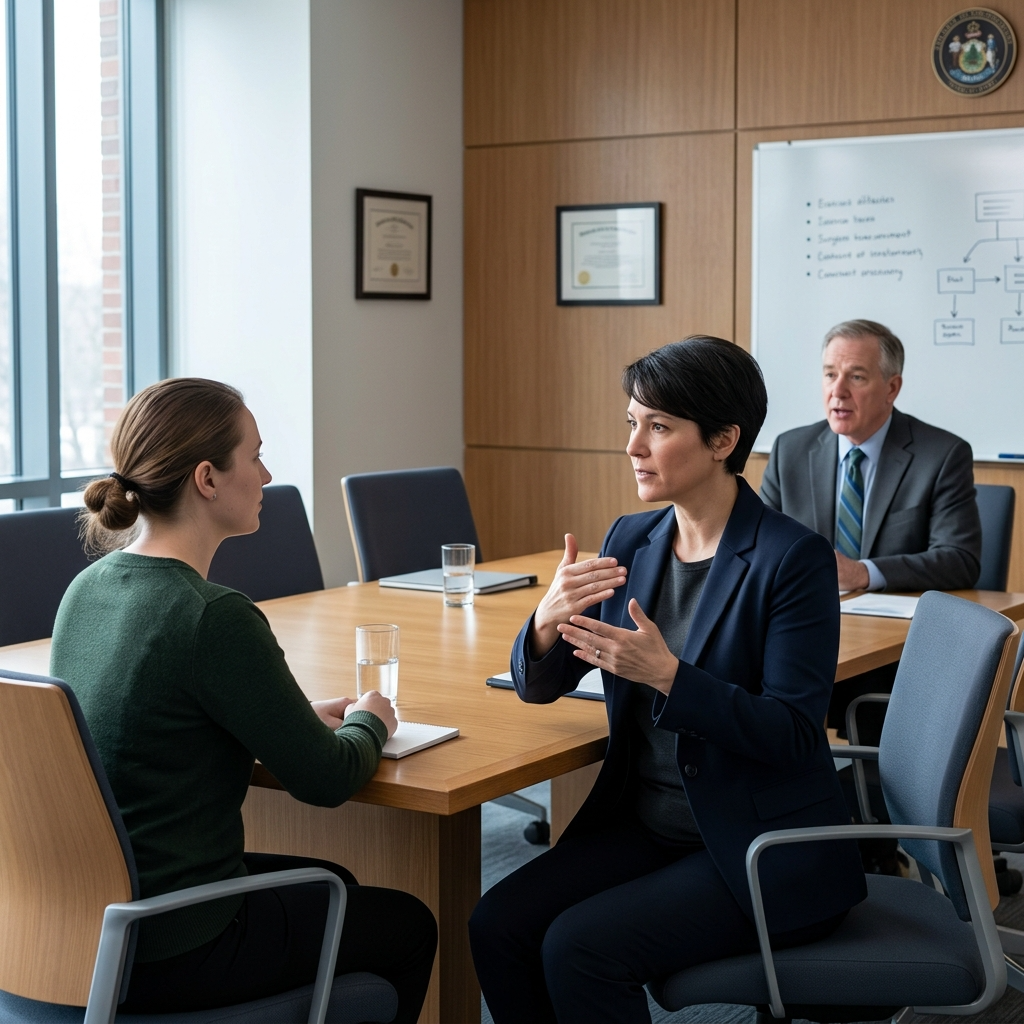
When a gunman opened fire in Lewiston, Maine on October 25, 2023, the deadliest mass shooting in the state’s history, emergency responders scrambled to reach every affected community. But for Maine’s Deaf and hard-of-hearing residents, the crisis exposed a gap that had nothing to do with response time or resources. It had to do with communication access.
The aftermath produced a 2024 report from Maine’s Department of Health and Human Services called the Transforming Interpreting Maine (TIME) needs assessment. That report, in turn, produced a piece of legislation now moving through the 132nd Maine Legislature: House Paper 1402, An Act to Amend the Laws Governing the Licensure of American Sign Language Interpreters.
It’s a quiet bill. Three sections. No sweeping overhaul. But the changes it proposes and the national context surrounding interpreter licensure, tell a compelling story about how states are grappling with interpreter access, professional standards, and the tension between protecting quality and meeting demand.
What the Maine Bill Actually Does
H.P. 1402 makes three targeted amendments to existing Maine law:
It creates an emergency exemption. Under the proposed language, licensure requirements would not apply to a person providing communication assistance during a declared emergency. The director, in consultation with the Commissioner of Professional and Financial Regulation, would have authority to determine when such conditions exist. This provision was drafted directly in response to the Lewiston shooting, where the absence of available licensed ASL interpreters during the crisis response created real, documented harm.
It broadens the educational pathway. Currently, Maine’s conditional licensure pathway requires an associate degree or higher in ASL, ASL interpreting, or deaf studies specifically. The amendment would accept an associate degree or higher in any field from an accredited institution. This is a meaningful shift. It acknowledges that talented, capable interpreters may arrive through varied academic backgrounds and that narrowly defined prerequisites can function as a bottleneck rather than a quality filter.
It extends the conditional licensure window. Maine currently allows candidates to hold a conditional license, essentially a supervised, pre-certification license for interpreters still working toward full credentials, for up to four years, with a fifth year available in cases of extreme hardship. The bill extends the base period to five years and the hardship extension to six. This gives emerging professional interpreters more runway to complete the certification process without losing the ability to work.
Taken together, these three changes reflect a pragmatic, access-oriented philosophy: maintain standards, but remove the obstacles that keep qualified people from serving their communities.
The National Landscape: A Patchwork of Approaches
Maine’s bill is not happening in a vacuum. There is no national requirement for ASL interpreter licensure in the United States: each state sets its own rules, producing a regulatory patchwork that can be difficult to navigate for professional interpreters and the organizations that hire them.
As of 2024, roughly half of U.S. states require some form of ASL interpreter licensure. Alabama, Arizona, Arkansas, Idaho, Illinois, Iowa, Kentucky, Maryland, Missouri, Nebraska, and others all have formal requirements. California, home to the largest Deaf community in the country, has none. Neither do Colorado, Florida, Massachusetts, or Washington. Those states rely on national certification through the Registry of Interpreters for the Deaf (RID) to signal quality, with no state-level enforcement when an uncredentialed individual takes assignments.
The shortage underlying all of this is significant. The RID lists approximately 10,000 certified ASL interpreters serving a Deaf and hard-of-hearing ASL-using population of roughly 500,000: about 50 Deaf individuals for every one certified interpreter. Every credentialing obstacle that pushes capable interpreters out of the workforce makes that ratio worse.
Among states that do require licensure, the approaches vary considerably. Maryland launched its program on January 1, 2025, with tiered requirements for interpreters in medical and behavioral health settings, treating specialized contexts as requiring specialized credentials. Illinois requires BEI certification before a state license can be issued and built its oversight commission to include deaf and hard-of-hearing consumers alongside licensed practitioners. Alabama specifically mandates licensure for legal interpreters, recognizing that courtroom and deposition work carries consequences that generic credentialing standards don’t fully address.
On provisional pathways, the issue Maine’s bill directly targets, states are equally divided. Some offer a one-time, non-renewable provisional license valid for three years. Others allow annual renewal for up to four years. Maine’s proposed extension to five years (six in hardship cases) reflects a clear signal: pushing trained-but-not-yet-certified interpreters out of the workforce before they cross the finish line creates more harm than it prevents. Maine’s emergency exemption, a formal director-authorization mechanism with no clear parallel in any other state’s statute, takes that logic one step further. No interpreter licensure law was written with mass casualty events in mind. Silence during a crisis is its own harm, and Maine is the first state to codify that reality into law.
What This Means for Organizations That Rely on Interpretation and Translation Services
For law firms, corporations, government agencies, and healthcare organizations, the national inconsistency in ASL interpreter credentialing mirrors a broader challenge in professional interpretation generally: not all interpreters are created equal, and not all credentials are equivalent.
Whether your need is for in-person interpretation at a deposition, simultaneous interpretation at a corporate event, legal translation of documents, or remote virtual interpretation services, the quality and credential verification process matters enormously. A certified interpreter in a legal setting, whether that’s a court certified interpreter handling sworn testimony, a deposition interpreter working through complex discovery, or an ASL interpreter facilitating communication with a Deaf witness, brings accountability that an uncredentialed individual simply cannot provide.
The right interpretation and translation agency handles that verification before the interpreter ever walks into the room. It’s not just a professional standard. In a courtroom, it’s the difference between a proceeding that holds up and one that doesn’t.
At Kaplan Interpreting Services, we believe that credentialing standards protect everyone at the table, not just the interpreter. Whether the setting is a high-stakes deposition, a multinational corporate conference, or an emergency response, the certified professionals in that room are the difference between communication and confusion.
Maine is getting it right. And the rest of the country is watching.
Kaplan Interpreting Services is a WBE/MBE-certified interpretation and translation agency based in Southern California, serving Am Law 100 firms, Fortune 500 companies, and government agencies since 2007. Our services include in-person court interpretation, simultaneous conference interpretation, document translation, and remote virtual interpretation in dozens of languages.

CEO & Founder
Born in Dallas, Texas, Alexandra grew up surrounded by Spanish, English, Arabic, and Italian. After moving to Venezuela, Spanish became her primary language. She holds a Master's in Healthcare Administration from Washington University in St. Louis and is a California court certified and medical interpreter.
She founded Kaplan Interpreting Services after seeing an industry that treated interpreters as interchangeable and clients as ticket numbers. She built a protocol-driven operation where every interpreter is hand-selected and credentialed for the specific setting, every client has a dedicated point of contact, and risk management is built into every assignment.
Her career reached a historic milestone when she interpreted the conversation between President-elect Biden and Pope Francis. That assignment, along with engagements for Nike and the Summit of the Americas, set the standard for every client engagement that followed.
"The same protocols that protected that historic conversation now protect every assignment we handle."